
CSS Units Guide: Convert px, rem, em, and Percent Without Guessing
Learn when to use px, rem, em, and percent values, why font-size context matters, and how unit conversion supports consistent design tokens.
Convert interface sizes between pixels, rem, em, and percent values before updating responsive CSS or design tokens.
Convert between px, rem, em, and percent values using your root and parent font-size context before shipping responsive interface styles.
CSS units converted locally in your browser.
16px
1rem
1em
100%
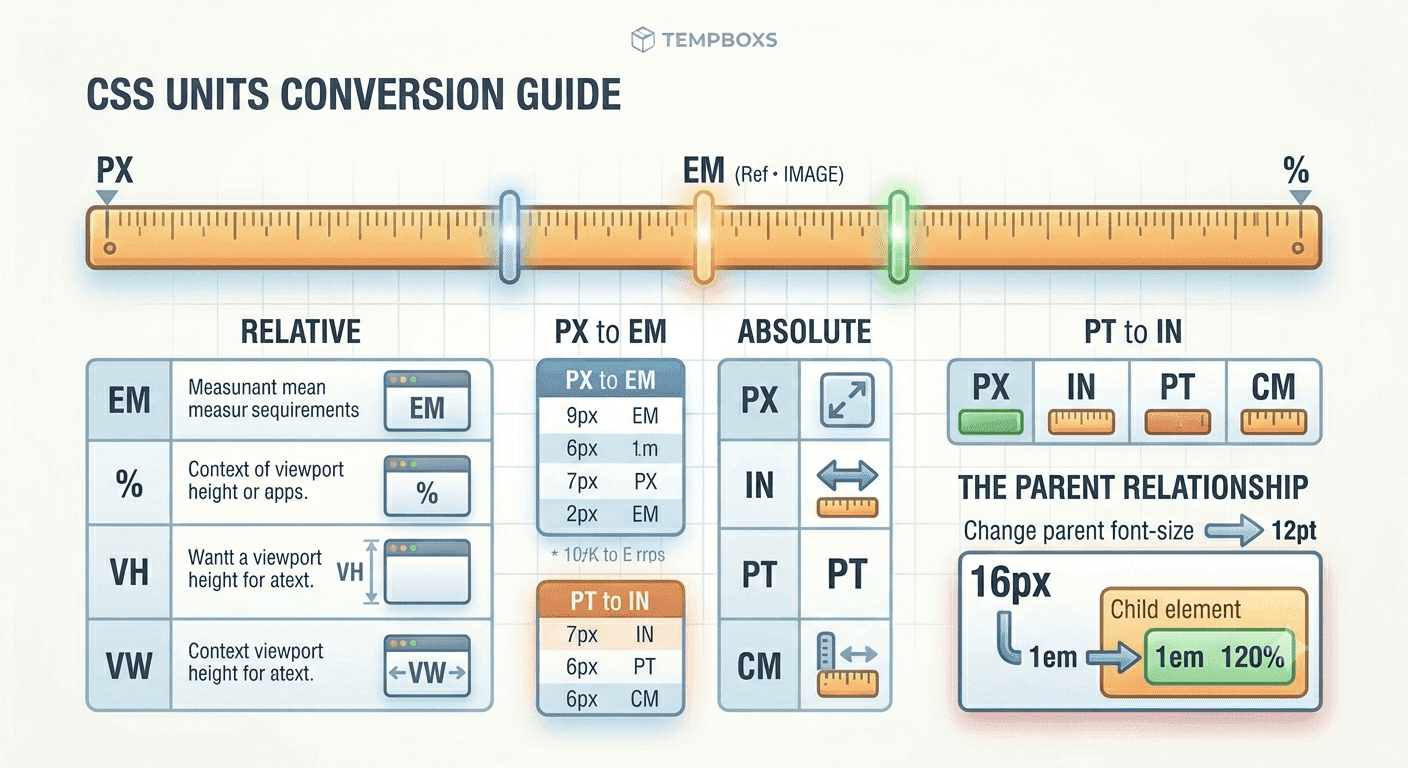
Pixels, rem, em, and percentages describe size in different ways. Pixels are direct screen CSS units, rem values depend on the root font size, em values depend on the parent context, and percentages are relative to the property being measured.
Converting units before editing a layout helps teams keep typography and spacing consistent with a design system instead of guessing values by sight.
Enter the source value, choose its unit, then set the root and parent font sizes used by your CSS. The converter shows equivalent px, rem, em, and percent values.
For most browser defaults, 1rem equals 16px. In nested components, 1em can be different because it follows the parent font size.
A converted value is a starting point, not a complete responsive decision. Check the component on mobile and desktop after updating CSS so text, controls, and cards still fit comfortably.
When a project has design tokens, convert values into the closest existing token when possible. That keeps the interface consistent and easier to maintain.
CSS values are converted locally in your browser. tempboxs does not receive pasted numbers or settings.
Translate px, rem, em, and percent values using the root and parent font-size context.
Review sizes before updating spacing, typography, buttons, cards, and responsive interface rules.
Copy a concise summary into pull requests, design QA notes, tickets, or documentation.
Learn more about privacy, tracking, passwords, and safer signups.
Learn when to use px, rem, em, and percent values, why font-size context matters, and how unit conversion supports consistent design tokens.

Learn how contrast ratios work, what WCAG AA and AAA thresholds mean, and how to review color pairs in real interfaces.
Learn how word count, reading time, headings, examples, and repeated terms can help you plan clearer guides without chasing arbitrary length.
Review content quality, policy pages, ad placement, crawlability, and technical files before AdSense checks.
Generate a Google AdSense ads.txt line and check pasted authorized-seller records locally before publishing.
Generate random UUID v4 identifiers in your browser, copy one value, or create a small batch for testing.
Convert Unix timestamps, milliseconds, ISO dates, and local-readable times locally in your browser.
Paste page HTML to inspect title tags, meta descriptions, canonical URLs, robots directives, Open Graph tags, and JSON-LD locally in your browser.
Generate JSON-LD schema markup for articles, FAQ pages, web pages, and browser tools locally before publishing.
Draft Open Graph and Twitter card preview tags locally for articles, tools, landing pages, and social shares.
Generate an llms.txt draft for AI discovery with public pages, useful tools, safety notes, and crawling guidance.
Generate sitemap XML from public URLs and check duplicate or invalid entries locally before publishing.
Paste robots.txt rules to test whether a URL path appears allowed or blocked for Googlebot, Bingbot, or another crawler locally in your browser.
Decode JWT headers and payloads locally in your browser, inspect claims, and learn what still needs verification.
Check password length, character variety, common patterns, and estimated guess resistance locally in your browser.
Paste email HTML to find likely tracking pixels, remote images, and marketing links locally in your browser.
Convert common YAML snippets into formatted JSON locally in your browser for configs, docs, and API examples.
Parse browser, operating system, device, engine, and bot hints from user agent strings locally in your browser.
Paste raw email headers to inspect sender fields, authentication results, and delivery hops locally in your browser.
Parse a URL into protocol, origin, hostname, port, path, query parameters, hash, and decoded components locally in your browser.
Encode URL text into percent-escaped values or decode encoded URLs locally in your browser.
Clean tracking parameters from links, decode common redirect URLs, and inspect domains locally in your browser.
Look up common DNS record types, purposes, examples, and setup notes locally in your browser.
Build campaign URLs with UTM source, medium, campaign, term, and content parameters locally in your browser.
Format, minify, and validate JSON locally in your browser with clear error feedback.
Encode HTML-sensitive characters or decode named and numeric entities locally in your browser for docs, blog posts, comments, and support replies.
Test JavaScript regular expressions, flags, matches, indexes, and capture groups locally in your browser.
Look up common file extensions, MIME types, categories, and delivery notes locally in your browser.
Preview Markdown headings, lists, links, inline styles, and code blocks locally in your browser before publishing docs or guides.
Generate a browser-only privacy checklist for signups, support tickets, link sharing, and publishing workflows.
Count words, characters, sentences, paragraphs, reading time, speaking time, and repeated terms locally in your browser.
Check foreground and background hex colors against common WCAG contrast thresholds locally in your browser.
Explain five-field cron expressions locally in your browser with readable field meanings and schedule warnings.
Convert CSV or tabular spreadsheet exports into formatted JSON locally in your browser with header and delimiter controls.
Convert text into lowercase, uppercase, title case, sentence case, slug, snake_case, kebab-case, camelCase, and PascalCase locally in your browser.
Look up common HTTP status codes, meanings, categories, and troubleshooting notes locally in your browser.
Encode plain text to Base64 or decode Base64 back to UTF-8 text locally in your browser.
Generate SHA-256, SHA-384, and SHA-512 hashes for text or local files without uploading them.
No. Unit conversion runs locally in your browser and does not send pasted values or settings to tempboxs.
Many browsers use 16px as the default root font size, but users and sites can change it. Use your project's actual root size when converting.
rem is based on the root font size. em is based on the current parent or element context, so nested components can produce different pixel values.
No. Use the unit that fits the design need. Typography and scalable spacing often work well with rem, while borders and precise effects may stay in px.