
A Guide to Disposable vs. Alias Emails
When to use a throwaway inbox, when an alias or plus-tag is enough, and how to pick the right pattern for privacy, deliverability, and long-term access.
- #disposable
- #alias
- #privacy
- #gmail
Start with the question you are really asking
Users Google “disposable vs alias” when a signup form is in front of them and they are unsure which pattern won’t create regret next week. The right answer depends on time horizon, trust, and whether you need that vendor to reach you after today. This guide matches each tool to that decision so you do not treat a throwaway like a long-term identity—or the reverse.
What the terms mean
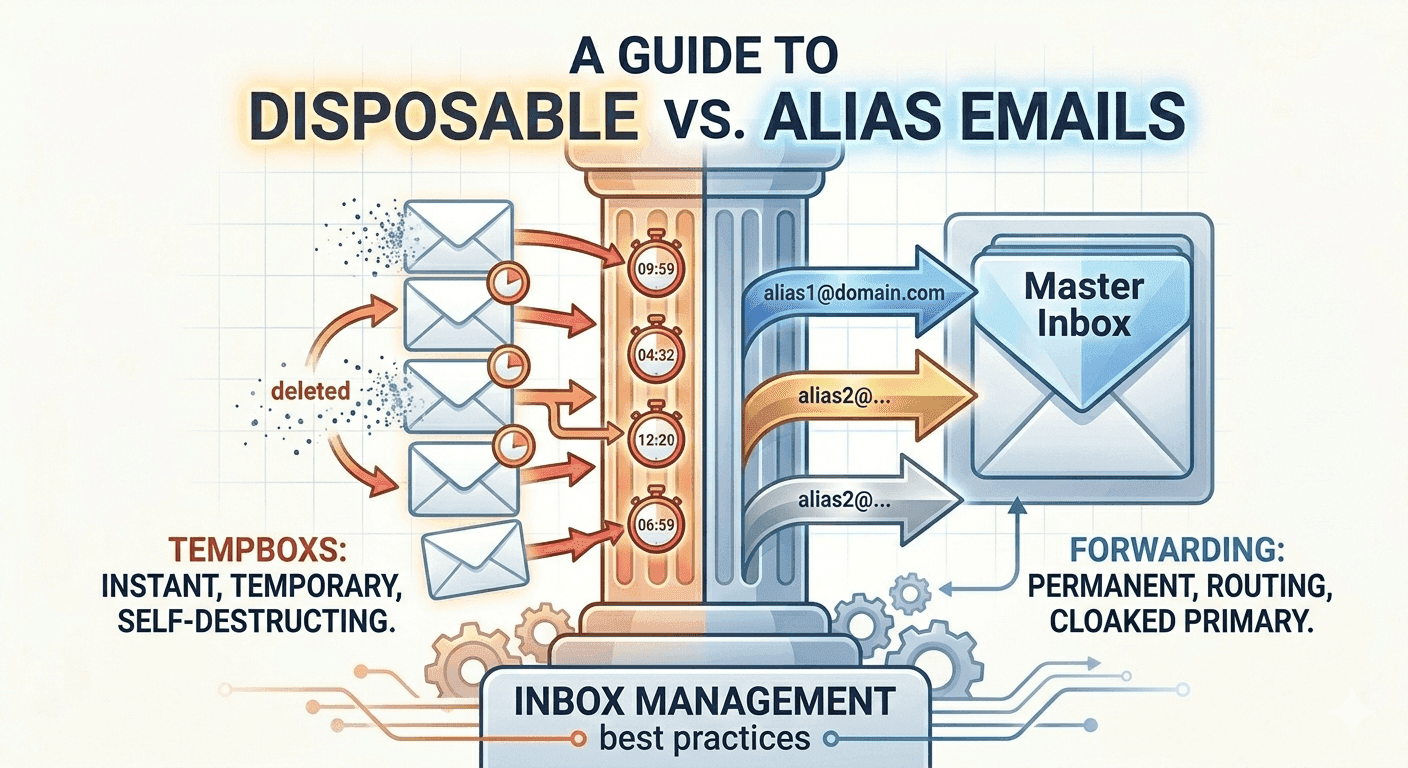
A disposable (or temporary) address is a mailbox that is not meant to last. It exists to receive a few messages—often a verification or receipt—and then it should disappear, taking stored mail with it. An alias (sometimes called a masked address or relay) is a forwarding identity: it receives mail on your behalf and passes it to a primary inbox you already control. A plus tag (like [email protected]) is a light variant of labeling: you still have one real mailbox, but you can see where the address was shared if the sender respects the full string.
Think of disposable as a booth number at a market: you can hear the pitch, but you are not giving anyone your home phone. Think of an alias as a second phone that still rings the same phone in your pocket—more private than shouting your number in a crowd, but the device is shared.
Privacy: separation vs. labeling
Aliases and plus tags help you organize risk; disposable mail helps you separate it. If a merchant sells an alias to a data broker, your main address may still be inferable depending on the provider, headers, and mistakes in templates. A good relay hides your true address in the To field for many scenarios, but you are still in one ecosystem. A disposable address on a dedicated domain for temp mail, by contrast, does not have to be tied to your name at all. For one-off signups, that separation is stronger than any filter rule.
If your threat model is “I do not want this startup to have my name-linked Gmail,” a relay is often enough. If your model is “I do not want any durable identifier at all for this one PDF,” disposable wins.
Lifespan and account recovery
Aliases win when you need the thread next month or next year. Password resets, order history, and subscription billing all assume you can still read the same inbox. Disposables are wrong for that job by design. If you register for something you might need to recover, use a durable identity with MFA on the backing account. If you are downloading a whitepaper, disposable is often perfect because the vendor’s “nurture” sequence is the threat model, not losing access in five years.
Students and small teams sometimes confuse “testing with temp mail” with “operations mail.” A QA inbox can be disposable; customer-facing addresses should not be. Keep the policy explicit in your runbooks: temp mail for throwaway, relay or corporate mail for everything that appears on an invoice.
Security and trust: what aliases do not solve
Aliases reduce exposure, but they do not automatically guarantee that the mail you receive is safe. A malicious sender can still attach risky files or include credential-harvesting links. The core rule stays the same: never open unexpected attachments, and never log in via a link you did not request. Go to the vendor directly via a bookmark or typed domain, then authenticate from there.
For high-risk accounts, treat your mailbox as part of your authentication stack. Use MFA on the email provider, prefer security keys or passkeys where available, store backup codes offline, and keep recovery emails out of a disposable inbox. Disposable mail is great for low-trust flows; it is a bad home for anything that might need recovery in the future.
Deliverability and blocking
Some sites block known disposable domains because abusers used them. Major relay providers and Apple’s Hide My Email are less likely to be rejected because they are widely trusted. If you are signing up for something that matters, check whether the form accepts the address. If you get rejected with a throwaway, that is a product policy, not a moral judgment—fall back to an alias or a dedicated secondary mailbox you control for the long run.
Legitimate services block disposable domains to reduce fake accounts, not to spite privacy advocates. Carry two strategies: a relay for human-scale trust, a disposable for machines-scale trials.
A simple decision table
Need a durable account, receipts, and resets? Use a real address, ideally behind an alias. Need a code once and never want follow-ups? Disposable. Need to see which brand leaked you? Plus tag or labeled alias. Need to test software mail without polluting your main inbox? Often disposable, sometimes a dedicated test mailbox, depending on compliance. tempboxs fits the disposable column: fast, no account, and time-bounded. Pair it with good habits for everything that should outlast a timer.
When in doubt, ask: will I be sad if this address stops existing tomorrow? If no, lean disposable. If yes, lean alias or main.